Policy Grant Proposal
Improving Educational Equity Through an Evidence-Based Funding Model for Central Virginia School Divisions
Original: 2021
Publish Date: 7/13/2026
Prepared By: Madison Roach
Target Audience: The Office of the Governor of Virginia & the Virginia Department of Education
Focus Region: Central Virginia School Divisions
Portfolio Repository: themadlab.squarespace.com
I. Project Overview
This proposal demonstrates my ability to synthesize policy research into a structured funding proposal for a public-sector audience.
Although originally developed as an academic project, this portfolio version has been substantially revised to reflect professional grant writing practices, including executive summaries, needs assessments, implementation planning, evaluation metrics, and evidence-based recommendations.
Project Context
Target Audience: Virginia Department of Education
Original Objective:
Develop a research-informed funding proposal addressing educational inequity within Central Virginia through an evidence-based pilot program.
Role: Sole researcher, writer, editor, and document designer
Project Goals
To systematically dismantle localized educational inequities, the pilot program anchors its implementation plan on four strategic milestones:
Reduce funding inequities among participating school divisions by decoupling resource allocation from local real estate values.
Improve access to instructional resources for historically underserved students by directing targeted financial support straight to high-poverty classrooms.
Pilot a transparent, student-centered funding formula that ensures public resources directly follow the individual student based on documented academic needs.
Establish measurable outcomes to generate clear, data-driven frameworks that can inform future statewide public education funding implementation.
II. Cover Letter
Educational outcomes across Virginia remain closely tied to geography, local property values, and historic patterns of segregation. This proposal presents an evidence-based funding framework designed to reduce inequities across Central Virginia school divisions through a pilot implementation of a student-centered funding model.
Currently, structural funding mechanisms within the Commonwealth inadvertently tie a child’s quality of education to their neighborhood zip code. The distribution of education funding across Virginia remains inconsistent, disproportionately straining schools in areas of concentrated poverty (McNeill, 2020). While the allocation of substantial funding packages—such as the $46.6 million in federal funding recently directed toward Virginia’s private schools—proves the state’s capacity for rapid educational investment (Office of the Governor of Virginia, 2021), an equivalent structural urgency must be applied to our public institutions.
This proposal narrows its focus to Central Virginia, where localized school division boundaries contribute significantly to deepening racial and economic segregation (Center for Education and Civil Rights, 2020). To remedy these disparities, this document outlines a pilot program implementing a Uniform Per-Student Funding Formula (UPSFF) and a Comprehensive Staffing Model (CSM) (Noth, 2019). This equity-based model ensures that financial resources directly follow the students who need them most.
Thank you for your time, consideration, and shared commitment to ensuring that every student in Central Virginia receives the equitable education they are constitutionally guaranteed.
Sincerely,
Madison Blaine
Lead Policy Analyst & Grant Writer
III. Executive Summary
Problem & Need: The American public education system is structurally restricted from serving as society's great equalizer due to persistent funding deficits in low-income communities. Within the Commonwealth, educational inequality is heavily entrenched, with Central Virginia serving as a clear indicator of localized, boundary-driven segregation. In the region's metropolitan areas, segregation between schools within the same division accounts for 56% of all multiracial school segregation, leaving urban and rural student poverty rates disproportionately high at 54% and 41% respectively (Center for Education and Civil Rights, 2020; McNeill, 2020). Under current methodologies, a student's educational outcome is unjustly dictated by regional real estate values rather than actual academic needs.
Solution: To achieve systemic equity, this proposal requests funding to launch a targeted, three-year pilot program in a high-need Central Virginia urban school division. The pilot replaces arbitrary enrollment-based budgets with a data-driven Uniform Per-Student Funding Formula (UPSFF) (Council of the District of Columbia, 1998) paired with a strict Comprehensive Staffing Model (CSM) (Noth, 2019). This equity-based framework ensures that financial resources directly follow the individual student to their specific building, ring-fences at-risk allocations from being diverted to baseline operational minimums, and implements a 95% budget stabilization floor to protect schools experiencing shifting demographics.
Funding Request & Impact: To successfully execute this pilot for a representative student body of 1,000 students (reflecting a 54% baseline poverty rate), we request a total grant investment of $14,185,800. This funding encompasses base student allocations ($10,980,000) alongside isolated equity supplements for At-Risk ($1,333,800), English Learner ($807,000), and Level 1 Special Education ($1,065,000) populations. Structurally isolated via the CSM, these resources will directly impact high-poverty classrooms by funding instructional coaches, interventionists, and specialized support staff to strategically lower student-to-teacher ratios where they are needed most (Noth, 2019).
Evaluation: The pilot's long-term viability and scalability will be rigorously measured quarterly by third-party educational auditors and the VDOE to ensure structural efficacy (Noth, 2019). Programmatic success will be evaluated across both process and summative metrics, requiring:
100% fiscal audit compliance, ensuring zero equity supplement dollars are diverted away to baseline capital operations.
A projected 10% year-over-year increase in standardized reading and math proficiency scores among the designated at-risk student cohorts.
Enrollment stabilization verification, confirming that the 95% budget floor successfully prevents structural layoffs or programmatic cancellations during demographic transitions.
IV. Statement of Need: Localized Segregation in Central Virginia
To effectively counter school segregation, policymakers must directly confront the intersection of housing boundaries, concentrated poverty, and race. Across the Commonwealth, students of color now represent the majority of K-12 enrollment at 51.6% (Center for Education and Civil Rights, 2020). However, historical and contemporary zoning patterns have created an uneven distribution of student enrollment by race among Virginia’s urban, suburban, and rural areas (Center for Education and Civil Rights, 2020).
Central Virginia faces a unique structural crisis: segregation between schools within the exact same school division drives the majority of the region's educational disparity (McNeill, 2020).
Division-Level Segregation: In Central Virginia’s metropolitan areas, segregation between schools within the same division accounts for 56% of all multiracial school segregation (McNeill, 2020).
The Independent City Factor: School division boundaries that surround independent cities act as artificial barriers, exacerbating racial and economic isolation across Central Virginia (Center for Education and Civil Rights, 2020).
This segregation aligns directly with severe economic divides. Evaluating eligibility for federal free or reduced-price lunch reveals that student poverty is concentrated heavily by school locale type (Center for Education and Civil Rights, 2020):
Under current funding methodologies, Central Virginia’s urban and rural schools lack a stable financial baseline. Because local property taxes fluctuate wildly across neighborhood boundaries, a student's educational outcome is unjustly dictated by regional real estate values. This proposal leverages state-level intervention to decouple school quality from local neighborhood income.
V. Proposed Solution: The Central Virginia UPSFF Pilot Program
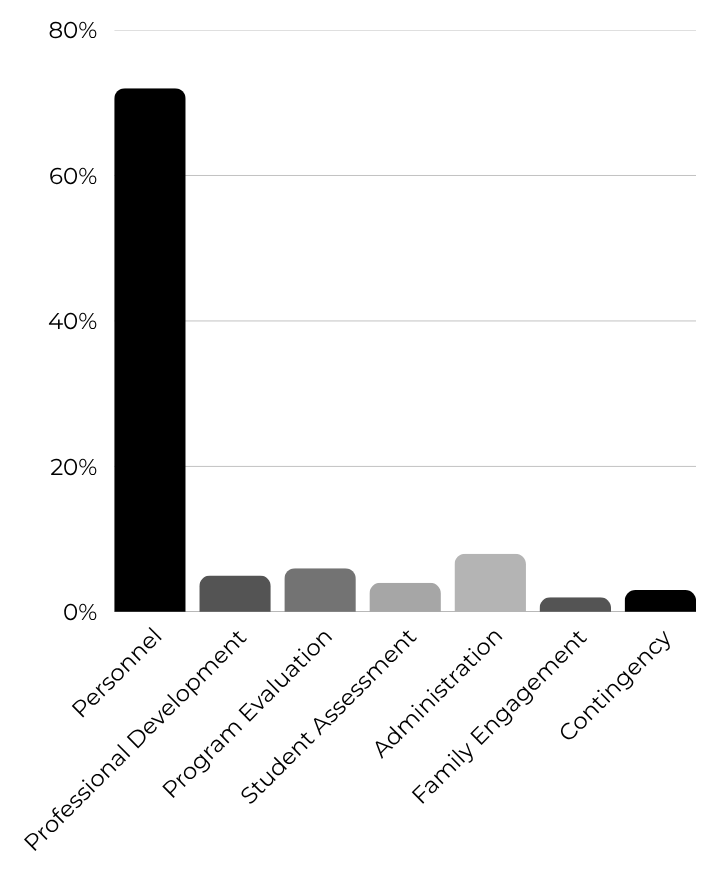
Budget Justification
Personnel: Approximately 70–80% of the supplemental allocation supports direct instructional personnel, including instructional coaches, interventionists, English learner specialists, and special education support staff. These positions expand instructional capacity, reduce student-to-teacher ratios, and provide targeted academic interventions.
Professional Development: Funds support ongoing training in evidence-based literacy and mathematics instruction, multi-tiered systems of support (MTSS), culturally responsive teaching, and progress monitoring.
Evaluation: Resources support annual performance measurement, implementation fidelity, student outcome analysis, and reporting to ensure accountability and continuous improvement.
Administration and Compliance: Administrative funding supports fiscal oversight, grant reporting, procurement, compliance monitoring, and coordination among participating schools.
The Proposed Solution
To correct these localized funding imbalances, this proposal seeks funding to launch a three-year pilot program in a high-need Central Virginia school division. The pilot replaces arbitrary enrollment-based budgets with a data-driven Uniform Per-Student Funding Formula (UPSFF) (Council of the District of Columbia, 1998) paired with a strict Comprehensive Staffing Model (CSM) (Noth, 2019).
Core Budgetary Principles of the Pilot:
Mandatory Resource Tracking: The pilot dictates that supplemental funding designated for vulnerable student populations must explicitly follow the student to their specific school building rather than being pooled into central division administrative funds (Noth, 2019).
Ring-Fencing At-Risk Allocations: Base operational costs must be calculated using flat UPSFF base numbers exclusively (Noth, 2019). School divisions are legally barred from using "at-risk" supplements to cover basic operational minimums, ensuring these funds remain strictly additive (Noth, 2019).
Stabilization Protection: To protect schools experiencing shifting neighborhood demographics, the pilot applies a strict stabilization law: no school's budget may drop below 95% of its prior-year allocation, mitigating the devastating impact of sudden staffing cuts (Noth, 2019).
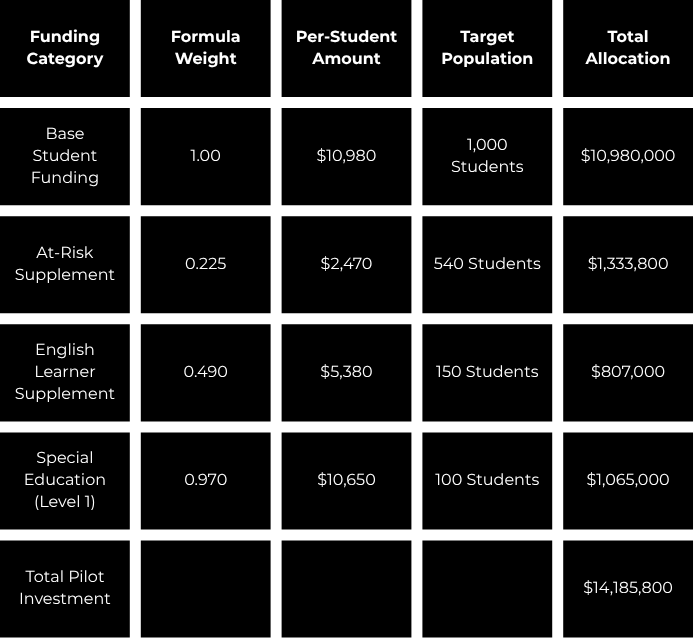
Table 1. Funding Formula (Hypothetical)
Quantitative Pilot Implementation Budget
The following hypothetical budget illustrates how the proposed funding model could be operationalized for a representative Central Virginia school division. Figures are intended to demonstrate budgeting methodology rather than represent an official funding request.
Specifically, the model below outlines an implementation budget for a pilot school within a Central Virginia urban center, serving 1,000 students with a baseline regional poverty weight of 54% (Center for Education and Civil Rights, 2020). It utilizes standard, verified policy weights to calculate funding extensions based on student vulnerability (Noth, 2019).
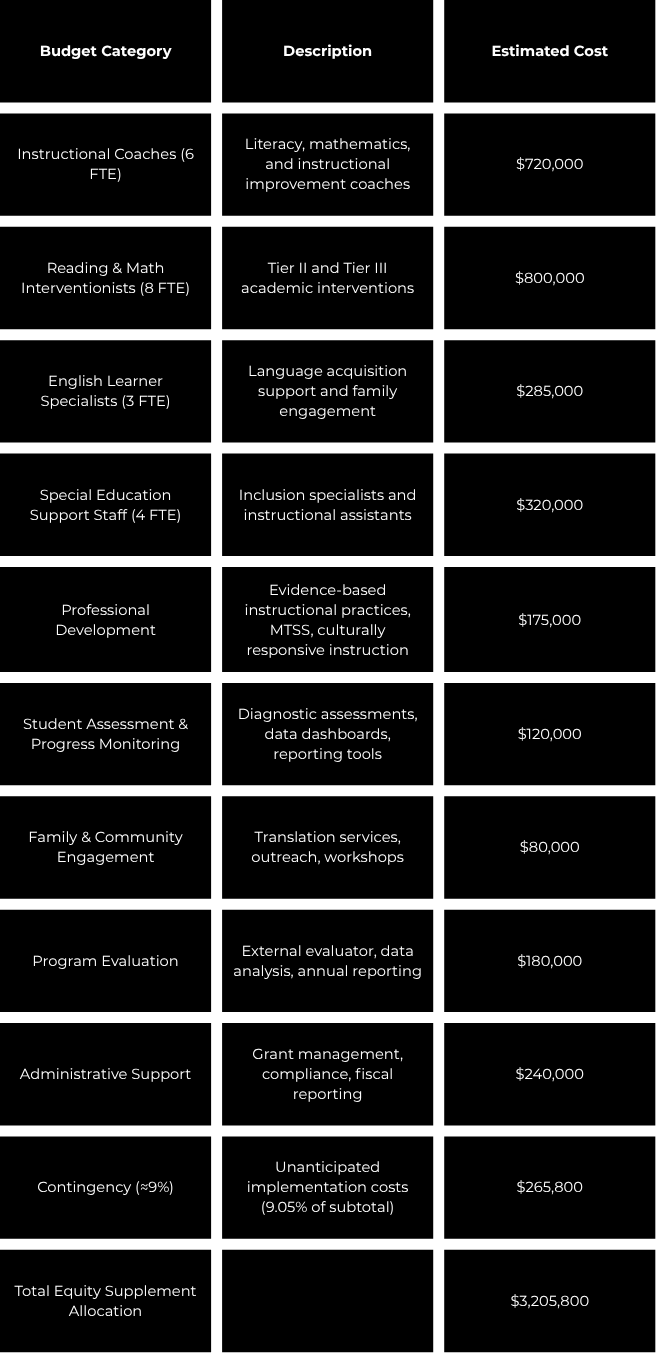
Table 2. Grant Implementation Budget
Proposed Use of Equity Supplement Funds
Fund Governance Directive: The approximately $3.21 million generated by the equity supplements (At-Risk, English Learner, and Special Education) is structurally isolated. These funds cannot be diverted to fill capital infrastructure deficits. They must be utilized via the CSM exclusively to hire instructional coaches, interventionists, and specialized support staff to reduce student-to-teacher ratios in high-poverty classrooms (Noth, 2019).
VI. Actionable Next Steps & Implementation Blueprint
To successfully execute this funding shift and actively mitigate division-level segregation, the Virginia Department of Education should coordinate the following programmatic steps within the target Central Virginia region (Center for Education and Civil Rights, 2020):
Establish the Office of Voluntary Integration: Launch a dedicated regional branch within the VDOE to support voluntary integration and oversee boundary adjustments (Center for Education and Civil Rights, 2020).
Mandate Equity Certifications: Implement mandatory training and certification requirements for Central Virginia school boards, superintendents, and principals focused on school segregation and integration (Center for Education and Civil Rights, 2020).
Reform Boundary Transparency: Authorize new state-level data collection for public use related to school attendance boundaries, forcing local real estate and zoning boards to evaluate the socioeconomic impacts of rezoning (Center for Education and Civil Rights, 2020).
Incorporate Integration into Accountability Measures: Update Virginia’s Every Student Succeeds Act (ESSA) state plan to include school segregation and integration as part of standard accountability measures (Center for Education and Civil Rights, 2020).
VII. Program Evaluation & Efficacy Metrics
To secure long-term state adoption, the pilot program will be held to rigorous transparency guidelines, measured quarterly by third-party educational auditors and the VDOE. Efficacy will be validated using the following process and summative metrics:
1. Fiscal Accountability (Process Metrics)
Audit Compliance: Achievement of 100% compliance in fiscal tracking, ensuring zero dollars of at-risk or special education supplements are diverted to baseline operations (Noth, 2019).
Staffing Verification: Documented execution of the CSM to ensure equitable distribution of highly qualified educators (Noth, 2019).
2. Student & Institutional Outcomes (Summative Metrics)
Closing the Achievement Gap: A projected 10% year-over-year increase in standardized reading and math proficiency scores among the designated at-risk student cohorts.
Enrollment Stabilization: Verification that the 95% budget stabilization floor successfully prevented structural layoffs or programmatic cancellations during periods of demographic transition (Noth, 2019).
VIII. Project Timeline
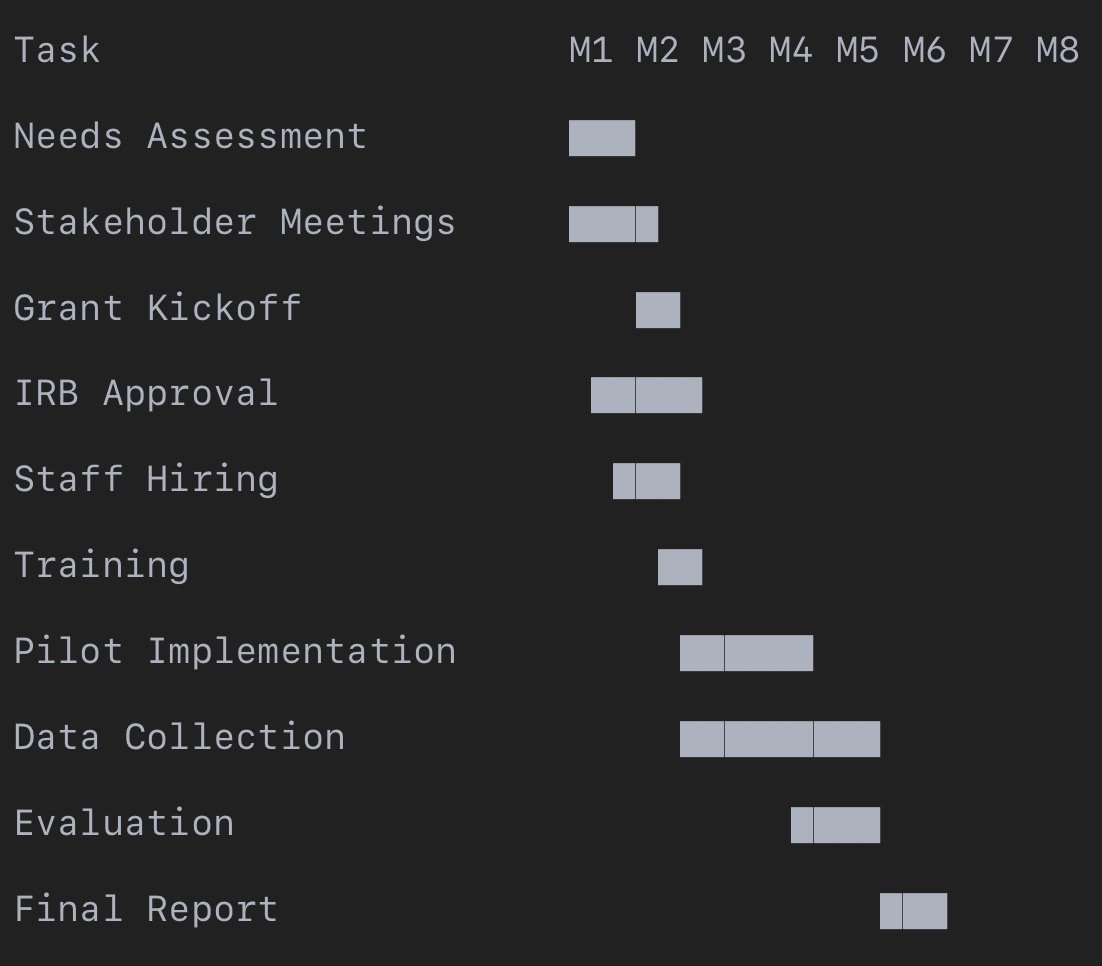
Activities are sequenced to minimize implementation delays while allowing overlap between training, stakeholder engagement, and evaluation planning. Progress is reviewed quarterly using predefined performance metrics and deliverables.
IX. References
Center for Education and Civil Rights. (2020). School segregation by boundary line in Virginia: Scope, significance and state policy solutions. Virginia Commonwealth University.https://scholarscompass.vcu.edu/edlp_pubs/13/
Council of the District of Columbia. (1998). Uniform Per Student Funding Formula for Public Schools and Public Charter Schools Act of 1998 (D.C. Official Code § 38-2901 et seq.).
McNeill, B. (2020, November 11). School segregation by race and poverty is deepening in Virginia, report finds. VCU News.https://news.vcu.edu/article/School_segregation_by_race_and_poverty_is_deepening_in_Virginia
Noth, A. (2019, December). The funding roadmap for educational justice in DC. DC Fiscal Policy Institute.https://www.dcfpi.org/all/the-funding-roadmap-for-educational-justice-in-dc/
Office of the Governor of Virginia. (2021, April 8). Governor Northam announces $46.6 million in federal funding for Virginia private schools. Commonwealth of Virginia.https://www.governor.virginia.gov/newsroom/all-releases/2021/april/headline-894356-en.html
Originally written: 2021
Revised: July 2026